Overview
veloGB10
A GB10-specific inference engine for one or two GB10-based systems — NVIDIA DGX Spark and compatible OEM machines built around the NVIDIA GB10 chipset.
veloGB10 (gb10_inference) is a from-scratch Rust + CUDA inference engine for a hand-selected
set of large language models — currently including the Qwen3.5/3.6/3.8 family and Tencent Hy3 — with
support for hybrid GatedDeltaNet + GQA architectures, dense models, and MoE models. More model
families are added deliberately rather than generically; each one is ported, measured, and gated
on real GB10 hardware before it ships.
The implementation is intentionally specialized for GB10 systems:
- One GB10 machine — single-node inference
- Two or four GB10 machines — tensor-parallel inference (TP=2 / TP=4) for performance, not just capacity: multiple machines decode a single request measurably faster than one can
- NVIDIA DGX Spark and compatible GB10 OEM systems (Grace Blackwell, sm_121)
- 128 GB unified LPDDR5x memory, ~255 GB/s measured sustained bandwidth
- ConnectX-7 networking for two-node inference
- GB10-specific kernels, precision paths, memory management, and scheduling
This project does not aim to provide generic GPU portability or support arbitrary hardware. The
same binary supports all supported models through --model-dir; no Python runtime or framework
serving stack is required.
Headline (greedy, MTP-speculative, bitwise-lossless — full tables in Benchmarks): Qwen3.8 27B at ~40 tok/s on one GB10 and ~56 tok/s on two (and ~85 tok/s on four with DFlash 2) · Qwen3.6 27B at ~42 tok/s on one GB10 and ~53 tok/s on two · Qwen3.6 35B MoE at ~111 tok/s on one GB10 and ~130 tok/s on two · Qwen3.5 122B MoE at ~39 tok/s on one GB10 and ~57 tok/s on two.
Prebuilt binaries for GB10 systems are on the Releases page — each release includes the inference binary, the required PTX kernels, SHA-256 checksums, and build provenance notes. If you run an NVIDIA DGX Spark or a compatible OEM GB10 machine, you can use a release binary without compiling anything.
Update — Qwen 3.8 27B NVFP4 with DFlash 2
veloGB10 now fully supports the Qwen3.8 27B NVFP4 model, with native DFlash 2 speculative decoding, at the model's full 256K context.
The supported configuration combines our NVFP4-quantized
Qwen3.8-27B-NVFP4-FULL target model with
the mirrored Qwen3.8-27B-DFlash2 drafter —
launched via --spec-source dflash2-auto --draft-dir <dflash2 dir> — and runs at max-seq-len
262144 (full 256K context).
Qwen 3.8 27B NVFP4 performance
Single-stream decode, greedy, NVFP4 with DFlash 2. Figures are representative; real numbers vary with content type. Highest performance is on code generation. "Average" is a representative blend across content types (see the note below — a code-heavy run averages much higher).
| Mode | Average | Bottoms | Peaks | Max sustained (code) |
|---|---|---|---|---|
| Single node | > 40 tok/s | ~11 tok/s | ~100 tok/s | ~70 tok/s |
| TP=2 | ~56 tok/s | ~18 tok/s | ~105 tok/s | ~85 tok/s |
| TP=4 | ~85 tok/s | ~32 tok/s | ~150 tok/s | ~125 tok/s |
Averages span a wide range by content type. On a mixed-content run (the
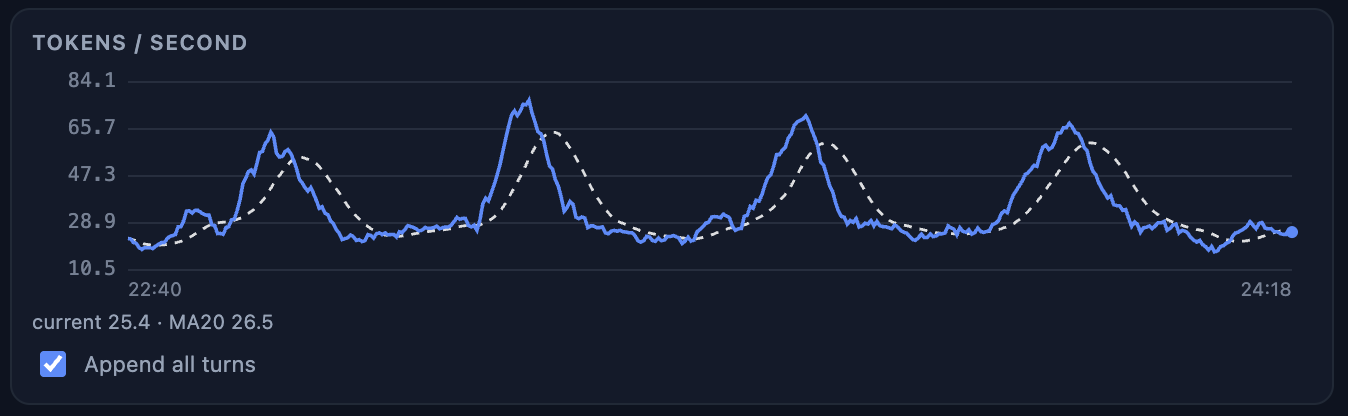
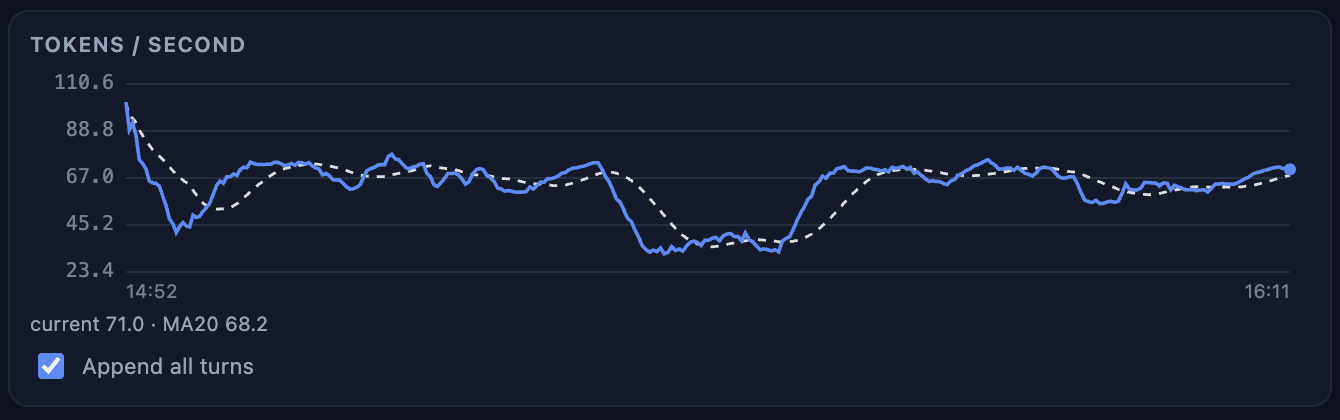
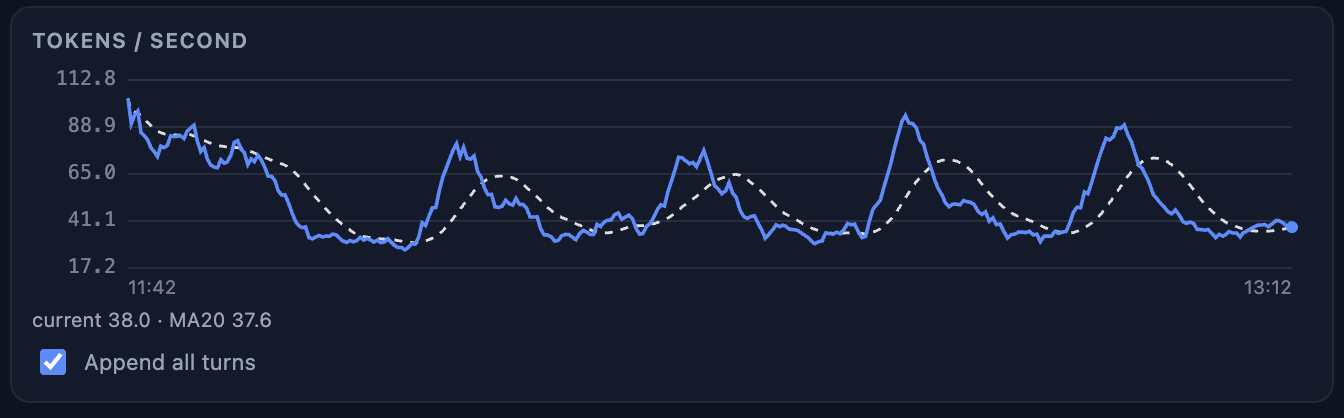
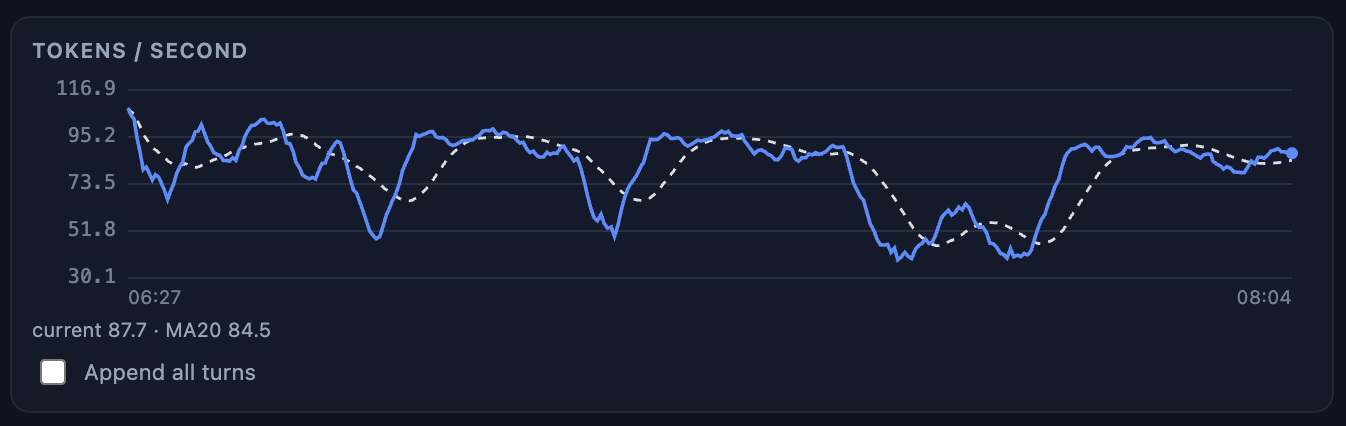
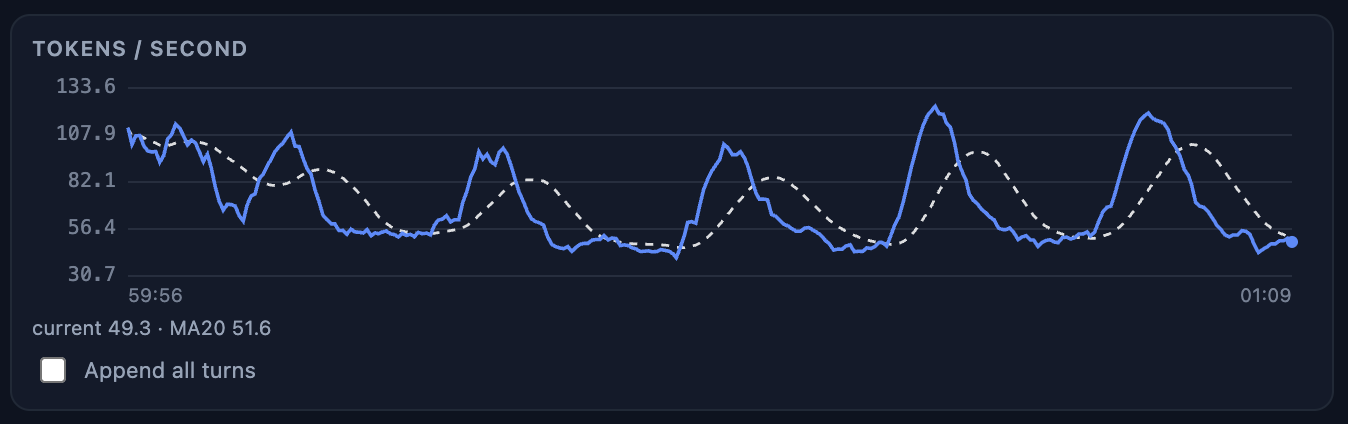
min_maxtraces below) the session average is ~25 / ~38 / ~51 tok/s for single / TP=2 / TP=4, whereas on a code-heavy sustained run (themaxtraces) it is ~70 / ~85 / ~125 tok/s. The "Average" column above is a representative figure across that spread; Peaks are the top reached on code-generation content; Max sustained (code) is the steady-state rate held during a code-heavy run (read from themaxtraces).Peak rates are typically reached on code content generation; prose and mixed content sit lower in the ranges above.
Live throughput traces (veloGB10)
These are TOKENS/SECOND traces pulled straight from the engine's live stats panel while serving
the Qwen3.8 27B NVFP4 + DFlash 2 config. For each deployment mode there's a peak-vs-lowest
trace (the full spread of a session — where throughput bottoms out and where it tops out) and a
sustained peak trace (a segment holding its best rate). Download the images to see them full-size.
Single node — mixed-content average ~26 tok/s, code-heavy sustained ~70 tok/s, some content types dip as low as ~11, and peaks reach ~100 on code. The peak-vs-lowest trace shows the swing between content types; the sustained-peak trace is a stretch running near the ~70–100 tok/s band.
| Peak vs lowest | Sustained peak |
|---|---|
 |
 |
TP=2 — the two-node setup lifts the ceiling: mixed average ~38, sustained ~85, bottoms ~18, peaks ~105. Even the lowest points sit above the single-node average.
| Peak vs lowest | Sustained peak |
|---|---|
 |
 |
TP=4 — four-node serving pushes well past 100 tok/s on the best content: mixed average ~51, sustained ~125, bottoms ~32, peaks up to ~150. The sustained-peak trace holds a ~125 tok/s plateau with spikes near 150.
| Peak vs lowest | Sustained peak |
|---|---|
 |
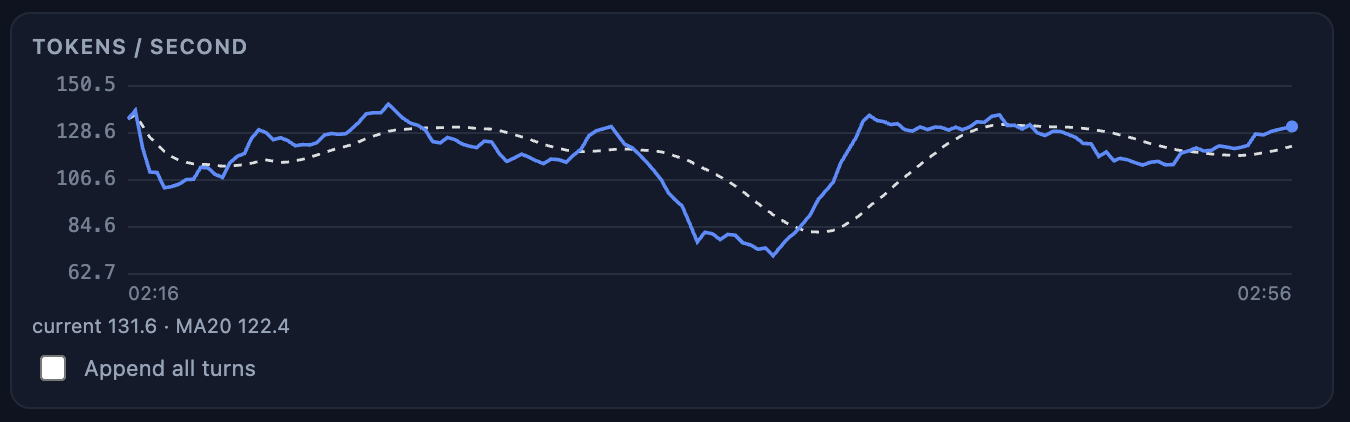 |
Scaling up from one to four nodes roughly doubles the ceiling (single ~100 → TP=4 ~150) and more than doubles the sustained average on code-heavy content (single ~70 → TP=4 ~125).
Comparison with other Qwen3.8 27B recipes
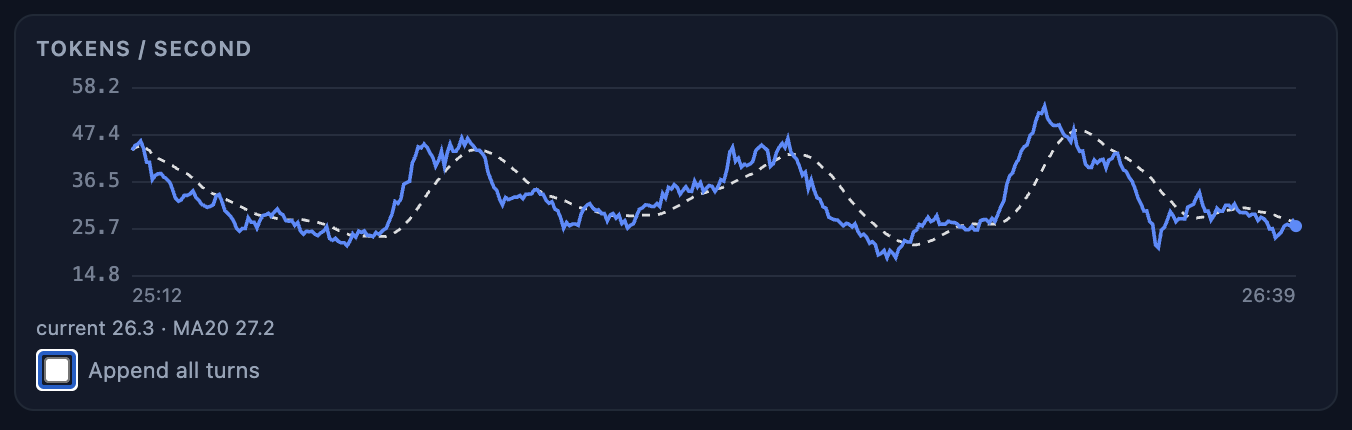
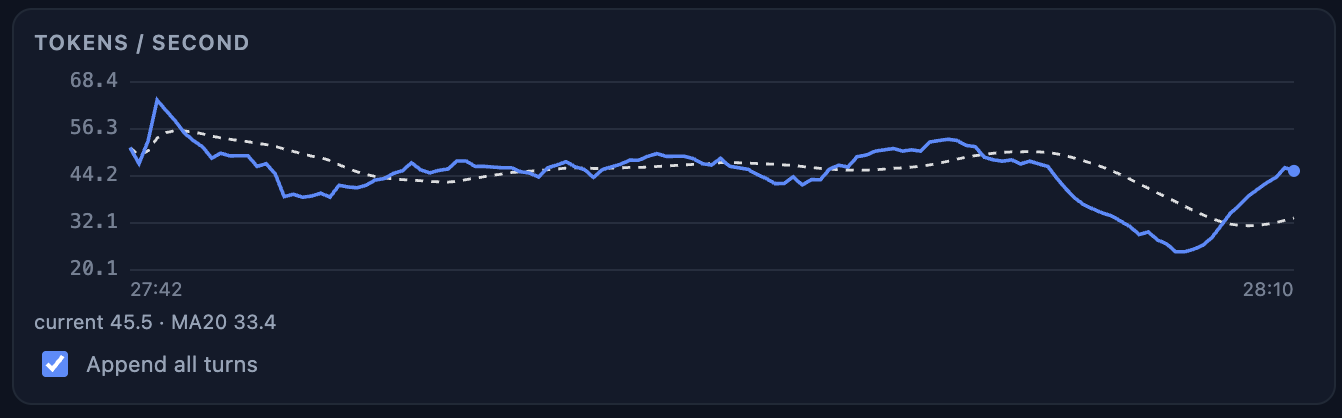
Same TOKENS/SECOND scale and format, but these are community SGLang recipes running the
Qwen3.8 27B on a single DGX Spark (not veloGB10). They are shown for side-by-side comparison only —
different kernels, quantization, and serving stacks, so treat the differences as informational, not
apples-to-apples. Each pair is the same peak-vs-lowest / sustained peak split as above.
Mia AI Lab — Qwen3.8-27B-SGLang-DGX-Spark (repo): single-node and two-node (TP=2) SGLang serving.
Single node:
| Peak vs lowest | Sustained peak |
|---|---|
 |
 |
TP=2:
| Peak vs lowest | Sustained peak |
|---|---|
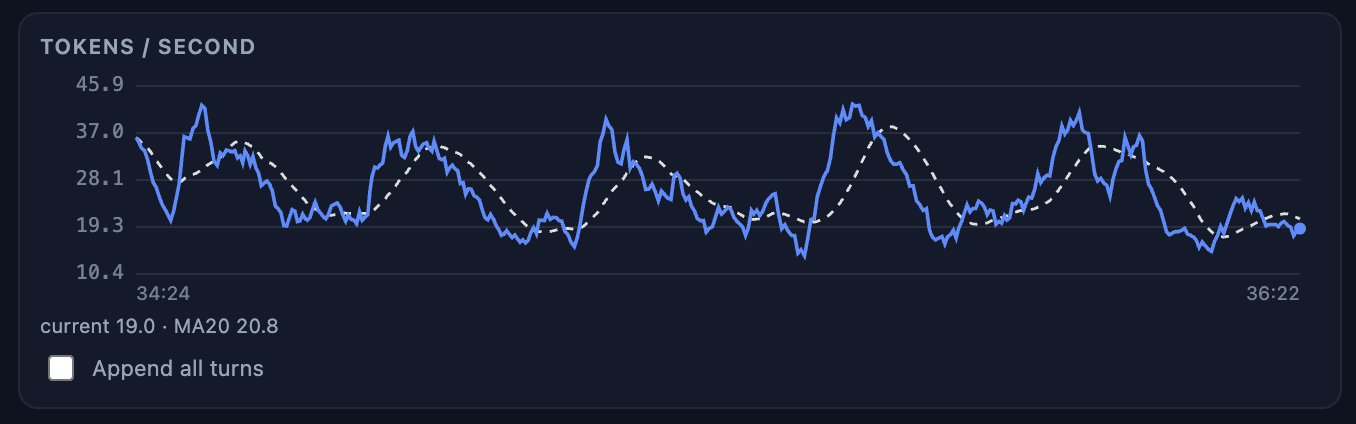 |
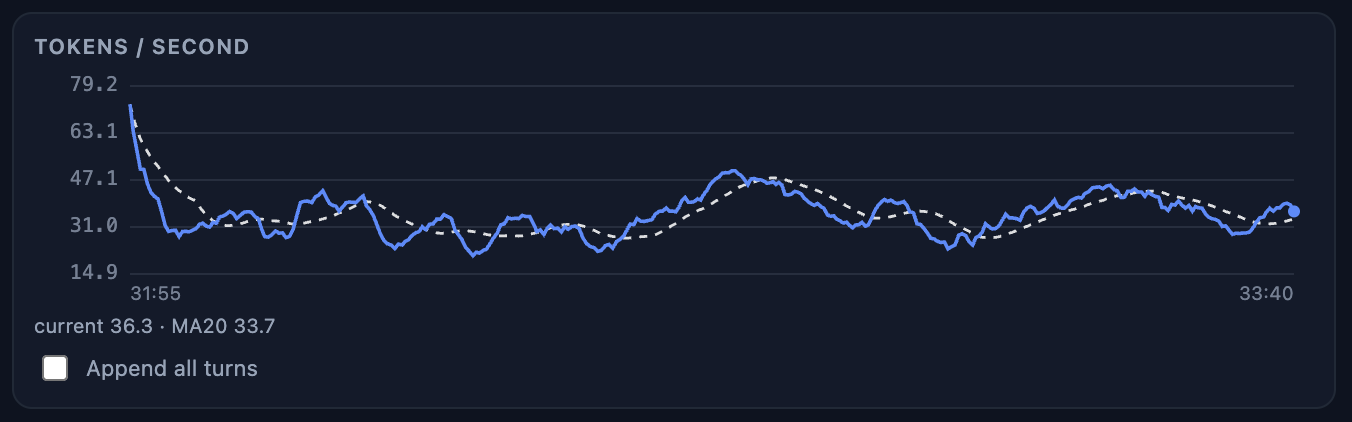 |
Hasso — dgx-spark-qwen38 (repo): single-node SGLang serving.
| Peak vs lowest | Sustained peak |
|---|---|
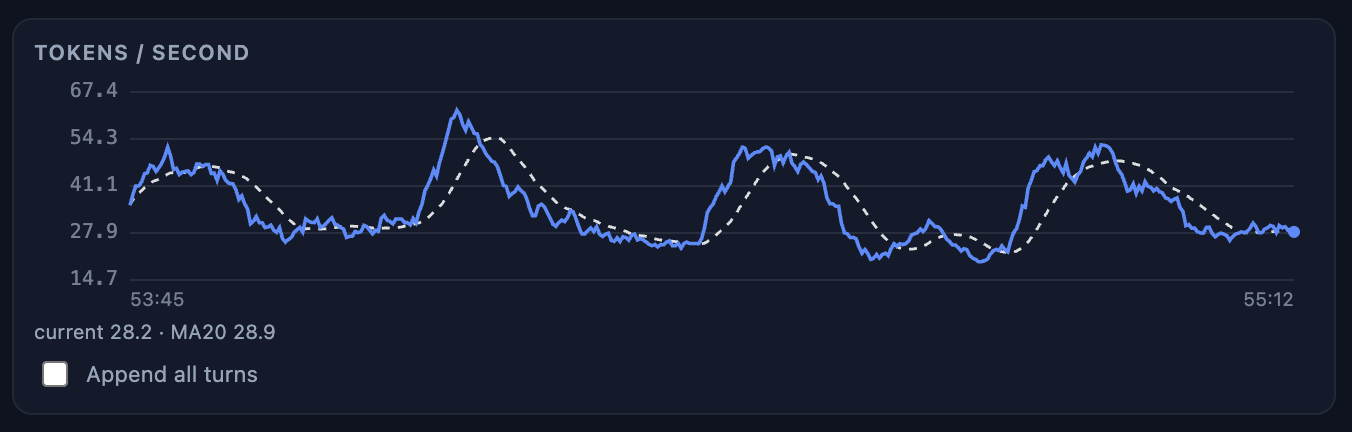 |
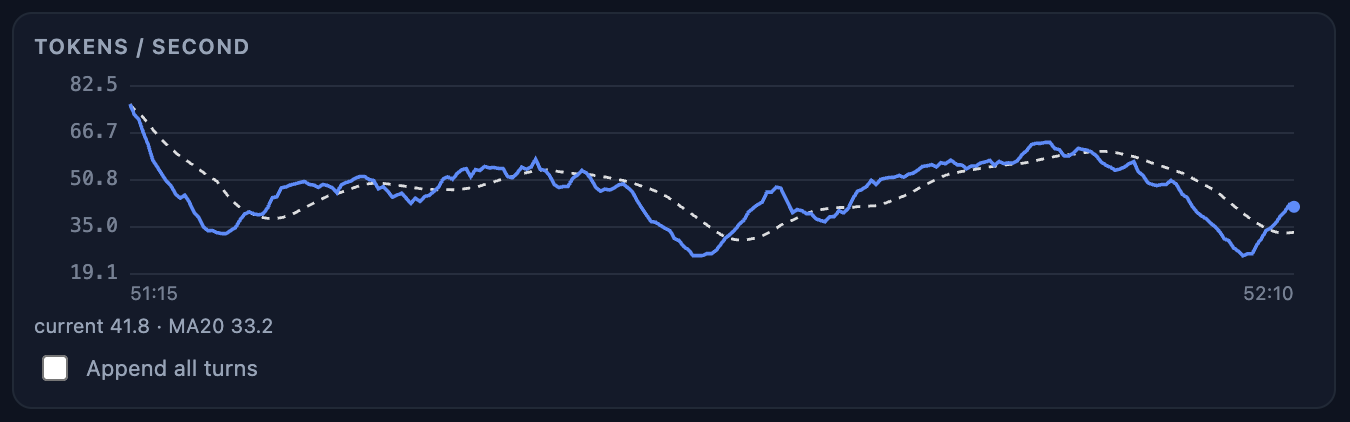 |
Recipe comparison (single-node scale)
Side-by-side figures for all the recipes shown above. veloGB10's own rows are included for
reference. Peaks are the top reached; Max sustained (code) is the steady-state rate held on
code-heavy content (read from the max traces). Averages are a representative blend across content
types;
| Recipe | Config | Average | Bottoms | Peaks | Max sustained (code) |
|---|---|---|---|---|---|
| veloGB10 | Single node | > 40 tok/s | ~11 | ~100 | ~70 |
| veloGB10 | TP=2 | ~56 tok/s | ~18 | ~105 | ~85 |
| veloGB10 | TP=4 | ~85 tok/s | ~32 | ~150 | ~125 |
| Mia AI Lab | Single node | ~27–42 tok/s | ~15 | ~58 | ~42 |
| Mia AI Lab | TP=2 | ~21–37 tok/s | ~10–12 | ~45 | ~37 |
| Hasso | Single node | ~27–35 tok/s | ~19 | ~66 | ~35 |
veloGB10's peaks are higher than either SGLang recipe even at single node, and the gap widens with TP=2/TP=4. These are different kernels, quantization, and serving stacks — informational comparison only, not a controlled benchmark.
Getting started with Qwen 3.8 27B
Full, step-by-step setup instructions for single-node, TP=2, and TP=4 deployments (node layout, required files, launch commands, and expected output) are in QWEN_27B_SETUP.md. The Tencent Hy3 model's two-node TP=2 bring-up is in HY3_SETUP.md. Managing the engine's TP model cache is documented in MANAGING_CACHE.md. If you want to see how the stack holds up under a long run, there's an 8-hour endurance report — throughput, latency, determinism, and thermals over a mixed workload — in ENDURANCE_REPORT.md. Release-by-release highlights are in CHANGELOG.md.
Notes
- TP=4 does not eat the whole cluster. Running the Qwen3.8 27B NVFP4 model across 4× DGX Spark does not mean you can't run anything else on those boxes. The model occupies roughly 45 GB on the head and about 20 GB on each node, so each GB10 still has plenty of headroom to run other processes. On a fully idle DGX Spark (~113 GB available) the steady-state estimate for the model is far under the machine's total memory.
- Vision is supported. Image input runs on the GPU vision tower, with a
--vision-cpuescape to the CPU reference path. PNG/JPEG/WebP/GIF images are supported.
Building from source
System prerequisites (on the GB10 itself):
- NVIDIA DGX Spark (GB10, sm_121) with the CUDA toolkit —
nvccavailable (CUDA_HOMEis honored). The build compiles the two kernel modules to PTX and fails loudly if nvcc fails; on a machine without nvcc it falls back to the checked-in PTX insrc/ptx/with a warning, so the Rust side can still be compiled anywhere. - Rust stable toolchain (
rustup). - libibverbs + rdma-core dev headers (for the TP=2 transport shim):
sudo apt install libibverbs-dev rdma-core
Build:
cargo build --release
This produces target/release/gb10_inference plus the two PTX kernel artifacts in src/ptx/.
The binary is not self-contained — it loads src/ptx/*.ptx relative to its working directory,
so run it from a directory that has both (a build-fingerprint handshake refuses to run mismatched
binary/PTX pairs, so the two never silently drift apart).
Don't want to build? Use the prebuilt package on the Releases page instead.
Running
Qwen3.8 27B with DFlash 2 requires the draft-model arguments. Add
--spec-source dflash2-auto --draft-dir <path/to/Qwen3.8-27B-DFlash2>to the launch command, and point--model-dirat the DFlash2-capable quantized model. The Qwen3.8 27B NVFP4 model is not a standalone drafter runner — it needs the DFlash2 drafter for speculative decoding. See QWEN_27B_SETUP.md for the full Qwen3.8 27B command lines.
Single node, single user (maximum speed):
./gb10_inference --server --model-dir=/path/to/model --port=9000 \
  --max-seq-len=32768 --max-batch=1 --prefix-cache=on --mtp=auto
Single node, ~4 concurrent users (maximum aggregate throughput):
./gb10_inference --server --model-dir=/path/to/model --port=9000 \
  --max-seq-len=32768 --max-batch=4 --mtp-lanes=on --prefix-cache=on
Two nodes, TP=2 (start the peer first — it needs no model copy and no configuration; the head ships weights, settings, and calibration at sync):
./gb10_inference --node --port 29500                                    # on the second GB10
./gb10_inference --server --model-dir=/path/to/model --tp \
  --nodes <peer-ip>:29500 --port=9000 --max-seq-len=32768 --prefix-cache=on   # on the head
Where the node's copy of the model lives: on first sync the node fetches the model from the
head into a content-addressed cache at ~/.cache/gb10_tp/ on the node machine:
blobs/— the model artifacts, each named by its SHA-256. Identical blobs are stored once and shared across models.models/<model-name>/— symlinks intoblobs/; this directory is what the node presents to the loader as the model. The[node] manifest '<model>': N artifacts, X cached, Y to fetchlog line counts exactly these blobs.hashcache.json— memoized file hashes so later syncs skip re-hashing the model.
Only missing blobs are transferred, so the second start of the same model syncs nothing. The cache is safe to delete (it just re-fetches over the network) — but keep an eye on disk headroom: a 122B recipe is ~76 GB.
Purpose
The DGX Spark has one scarce resource: ~255 GB/s of measured, sustainable memory bandwidth. Every design decision in this engine is subordinate to spending it well. The result is an engine that runs large models — up to 122B on a single node, larger across two — at speeds that hold up under an agentic workload, not just on a benchmark prompt.
Two properties are treated as non-negotiable and are enforced by gates, not by hope:
- Correctness is bitwise. The serving GEMM is batch-invariant: a speculative verify of width N produces results bit-identical to N separate decodes. Greedy speculative decoding is therefore exactly lossless — same tokens, same bytes — and stochastic decoding is distribution-exact.
- Numbers are measured. Decode rooflines, TP speedups, and acceptance rates in this README come from the engine's own gates on this hardware. Where a number is an estimate, it says so.
What it does today
- OpenAI-compatible server — streaming, tool calling (schema-aware argument coercion, with a
single canonical serializer across streaming and non-streaming), seedable sampling, continuous
batching, prefix caching, and OpenAI
reasoning_effortlevels (none/low/medium/high/xhigh/max). Also exposes vLLM-compatiblePOST /v1/tokenizeandPOST /v1/detokenizeendpoints for benchmarking. - Vision — image input on a GPU vision tower across the Qwen3.5/3.8 VL family
(
--vision-cpufor the CPU reference path); PNG/JPEG/WebP/GIF. The tower bootstraps opportunistically: a non-vision or incompatible model serves text-only, never a startup crash. - MTP speculative decoding — native multi-token prediction heads with an auto-depth policy that measures its own cost/acceptance trade-off live and re-picks depth (or disables itself) per workload. No configuration required.
- Two-node / four-node TP serving — see below.
- NVFP4 / FP8 mixed-precision quantization — offline quantizer producing HF-compatible compressed-tensors artifacts; NVFP4 tensor-core GEMMs for the serving path.
- Long context — chunked prefill; 32K-class envelopes validated end-to-end on TP=2; model-context up to 256K on the 27B. The hybrid GDN layers carry a fixed-size recurrent state, so KV memory grows only on the periodic full-attention layers.
- Supported models — one binary loads any of these; the model is a directory, not a build.
| Model | HF artifact | Architecture / recipe |
|---|---|---|
| Qwen3.5 0.8B | doth4580/Qwen3.5-0.8B-NVFP4-MIXED | dense hybrid, nvfp4-mixed |
| Qwen3.5 2B | doth4580/Qwen3.5-2B-NVFP4-MIXED | dense hybrid, nvfp4-mixed |
| Qwen3.5 4B | doth4580/Qwen3.5-4B-NVFP4-MIXED | dense hybrid, nvfp4-mixed |
| Qwen3.5 9B | doth4580/Qwen3.5-9B-NVFP4-FULL | dense hybrid, nvfp4-full |
| Qwen3.6 27B | doth4580/Qwen3.6-27B-NVFP4-FULL | dense hybrid, nvfp4-full |
| Qwen3.6 35B MoE | doth4580/Qwen3.6-35B-A3B-NVFP4-FULL | MoE hybrid, nvfp4-full |
| Qwen3.5 122B MoE | doth4580/Qwen3.5-122B-A10B-NVFP4-MIXED / GDN4 | MoE hybrid, nvfp4-mixed or gdn4 |
| Tencent Hy3 | doth4580/Tencent-Hy3-295B-A21B-NVFP4 | 295B-A21B pure-GQA MoE |
| KAT-Coder-V2.5-Dev | doth4580/Kwaipilot-KAT-Coder-V2.5-Dev-NVFP4-MIXED | 35B-A3B MoE hybrid, code specialist, nvfp4-mixed |
Unique aspects
Engineered to the roofline
The engine is ~94% GEMM and weight-bandwidth-bound, and it is tuned as such: on 9B the LM head sustains 229 GB/s — 90% of the machine's measured 255 GB/s pure-read ceiling — and the whole decode step runs at 72% of it. Optimization here means fewer bytes (NVFP4, fused projections, frequency-ranked draft vocabularies), not fewer launches.
Bitwise-lossless speculation
The quantized serving GEMM always runs one fixed shape (N padded to 16), so decode and verify execute an identical instruction sequence and column 0 is bit-identical by construction, not by argument. That is what makes greedy MTP lossless rather than approximately lossless — and it is gated as such, at contexts up to 27K, under statistical process control rather than pass/fail coin flips.
TP=2 as a performance mode
Two-node tensor parallelism is usually about capacity — splitting a model that doesn't fit. Here it is primarily a speed mode for a single user: split a model that does fit across two DGX Sparks and go measurably faster, because each node streams half the weights per token. Measured: 1.42–1.51× on 27B at 6–10K context (the regime agentic workloads actually live in), 1.34× on 122B, with the speedup growing with context.
And it is built to be trusted, not just to run:
- Zero-configuration node — start
--nodeon the second box and--server --tp --nodes <ip>on the head. The head communicates the model, all settings, and its calibration table at sync; the node reproduces the head byte-for-byte. There is nothing to keep in sync by hand. - Per-step agreement guard — both ranks hash their state every decode step and abort loudly on any divergence. Silent desync is not a failure mode this system has.
- Deterministic everything — auto-depth decisions are a pure function of bit-identical token history; output is byte-identical to the single-node build (gated, incl. live depth switches).
Hybrid-native long context
The GatedDeltaNet layers make prefix caching, MTP rollback, and KV management different here — the recurrent state exists at exactly one point in the sequence. The engine handles this natively (periodic GDN checkpoints, fed-not-emitted cache invariants), which is what makes both prefix caching (99% prefill skip on cache hits) and lossless speculation work on this architecture.
Benchmarks
Preliminary. All throughput and TTFT numbers below were measured with
tool-eval-bench --perf(OpenAI server path, pp2048 + tg128, 3 runs per cell) and veloGB10's own built-in benchmarks. A full benchmark run across all models × modes × contexts is in progress; these tables will be regenerated from it. Single-stream decode, greedy, NVFP4, unless noted.Benchmark network. These results were measured on the following network configuration: 4× Asus Ascent GX10 (OEM DGX Spark clones) connected to a MikroTik CRS812 DDQ (CRS812-8DS-2DQ-2DDQ) switch: 2 Sparks connect to the 200G ports with QSFP112 cables; the other 2 Sparks connect to the 400G port via a 1× 400G → 2× 200G splitter cable. All inter-box links were measured to be optimal (maxed out) at 111G.
Qwen3.5 family (tok/s, greedy, MTP auto unless noted)
| Model (recipe) | Single node | TP=2 |
|---|---|---|
| 0.8B (mixed) | 182–217 | 182–201 ¹ |
| 2B (mixed) | 150–169 | 159–166 ¹ |
| 4B (mixed) | 97–112 | 112–115 ¹ |
| 9B (full) | 71–83 | 83–90 |
| 27B (full) | 31–32 | 40–42 |
| 122B MoE (mixed) | 40–43 | 46–51 |
| 122B MoE (gdn4) | 39–48 | 49.5–54 |
Qwen3.6 family (tok/s, greedy, MTP auto unless noted)
| Model (recipe) | Single node | TP=2 |
|---|---|---|
| 27B (full) | 33–42 | 42–53 ³ |
| 35B MoE (full) | 98–111 | 118–130 ² |
Notes. "Pending" cells land with the full benchmark run (tool-eval-bench --perf);
ranges are across 0–8K context. ¹ TP=2 on the small models (0.8B, 2B, 4B) is unoptimized —
barriers dominate at these sizes: TTFT is several times slower for little or no decode gain; run
them single-node. TP=2 vs single, same harness: 27B 1.1–1.3× (best-vs-best 1.26×;
a matched-depth comparison measured 1.42–1.51× at 6–10K); 122B 1.1–1.3×; 9B is
wash at short context but ~1.26× at 8K (TP decode rises with context there). ² 35B: TP=2
leads at every measured depth (1.07–1.20×) — and halves per-node memory besides. ³ 27B TP=2 is
quoted best-of-runs (measured spread 42–53 tok/s across sweeps
— MTP acceptance variance; we report best-vs-best). MTP acceptance is workload-dependent (~35–85% across the family; prose accepts higher
than code).
Multi-client batching is weight-amortized and nearly free: 9B serves 4 concurrent clients at 34 tok/s each (~136 tok/s aggregate, 3.2× single-stream) with byte-identical output.
"Greedy-lossless verified" (LOSSLESS_OK in the engine's gates): speculative output bit-identical
to non-speculative decoding — speculation changes speed, never the tokens.
TP=2 also halves per-node memory (122B: 39 GB/rank vs 73 GB replicated), which is what makes large-model + long-context + multi-lane combinations fit.
Prefill
| Model | tok/s | Note |
|---|---|---|
| Qwen3.5 122B | 702 | grouped-MoE GEMM with N=16 weight reuse |
| Qwen3.6 27B | ~721 | 2.7 s TTFT on a 2048-token prompt |
Quality (tool-eval-bench, agentic scenario suite)
| Model | Single node | TP=2 |
|---|---|---|
| Qwen3.6 27B | 93/100 | 92/100 |
| Qwen3.5 122B | 88/100 | 88/100 |
Command-line reference
Complete surface of gb10_inference (same content as --help). Square brackets show defaults.
Modes
| Mode | What it does |
|---|---|
--server |
OpenAI-compatible HTTP server — the normal way to run (endpoints: POST /v1/chat/completions, POST /v1/tokenize, POST /v1/detokenize, GET /v1/models[/:id], GET /health) |
| (no mode) | Interactive CLI: load model, generate from --prompt |
--help, -h |
Print help |
Tokenize / detokenize (benchmarking)
Two vLLM-compatible endpoints expose the resident tokenizer for benchmarking and exact prompt construction. Both are pure tokenizer calls (no forward, no KV, no GPU work).
POST /v1/tokenize—{model, prompt (string | token-id list), add_special_tokens (default true), truncate_prompt_tokens (optional)}→{tokens: [ids], count, max_model_len}. Accepts apromptstring or a chatmessagesarray; themessagesmode renders exactly as the chat path does (shared reminder-effort resolution), so its count equalsusage.prompt_tokensfor the same conversation. An empty prompt returns{tokens: [], count: 0}(vLLM behavior); an over-length prompt returns400withcode: context_length_exceeded(truncation keeps the lastntokens).POST /v1/detokenize—{model, tokens, skip_special_tokens (default false)}→{model, prompt}. The decode half of the pair, for exact-N prompt building.
max_model_len mirrors the configured context size, so benchmarks can plan prompts that fit.
Server flags (--server)
| Flag | Default | Meaning |
|---|---|---|
--model-dir <DIR> |
required | Model directory (config.json + safetensors + tokenizer). The normal way to load |
--model-name <NAME> |
dir name | Name reported by /v1/models |
--model <FILE> |
— | Legacy: single .safetensors file (use --model-dir) |
--tokenizer <FILE> |
— | Legacy: tokenizer.json path (implied by --model-dir) |
--port <N> |
8000 | Listen port |
--max-batch <N> |
8 | Max concurrent sequences (lanes) |
--max-tokens <N> |
8192 | Generation cap when a request omits max_tokens |
--max-seq-len <N> |
4096 | The context size. KV cache is allocated to exactly this; prompts longer are rejected, over-long generations clamped. Clamped to the model's max_position_embeddings (256K this family). KV ≈ 64 KB/token/lane on 27B (hybrid GDN keeps this small); above ~12K, CUDA graphs are skipped (measured zero cost) |
--vision-cpu |
off | Force the CPU vision tower (reference path) instead of the GPU tower. Diagnostic/escape hatch |
--reasoning-effort <e> |
template default | Reasoning level in the chat template (no_think/low/medium/high/xhigh); per-request reasoning_effort overrides |
--output-prompts [n] |
off | Log each chat request human-readable (params, messages, rendered prompt); optional render cap n |
--mtp <auto\|on\|off> |
auto | MTP speculative decoding. auto measures whether it pays and self-tunes depth from live acceptance; greedy verify is bitwise-lossless, temp>0 distribution-exact. on/off force it (benchmarking) |
--mtp-depth <N> |
auto | Pin draft depth instead of auto-picking (benchmarking) |
--ngram-draft <N> |
0 | EXPERIMENTAL prompt-lookup drafting, n-gram order N (0 = off) |
--prefix-cache <on\|off> |
off | Reuse a conversation's cached prefix (~3× faster follow-up turns). Not bit-exact across reuse; greedy MTP stays lossless |
--default-repetition-penalty <F> |
1.0 | Repetition penalty (1.0 = off) |
--default-presence-penalty <F> |
1.5 (2.0 on 2B) | Presence penalty |
--default-frequency-penalty <F> |
0.0 | Frequency penalty |
temperature / top_p / top_k / seed are per-request only (defaults 0.7 / 0.8 / 20) —
every request may override in its JSON body. There are no MTP env vars; speculation is auto-tuned
per request.
TP=2/TP=4 flags (head) and node mode
| Flag | Default | Meaning |
|---|---|---|
--node [--port 29500] [--rdma-dev d1[,d2]] [--once] |
— | Run the node (peer) side: resident supervisor, zero configuration — model, config, cost table and stop tokens ship from the head at sync |
--tp |
off | Enable TP=2 on --server (sync + RDMA bring-up first) |
--nodes <ip[:port],...> |
— | Explicit node address(es); skips UDP discovery |
--discover-wait <S> |
3 | Discovery broadcast window (instead of --nodes) |
--rdma-dev <d1[,d2]> |
platform defaults | RoCE devices (also GB10_RDMA_DEV) |
--head --model-dir <DIR> |
— | One-shot bench/generate head (use --server --tp for serving) |
TP environment variables (read on the head, shipped to the node at sync; a node never needs them):
| Env var | Meaning |
|---|---|
GB10_TP_SHARD_MIXERS=1 |
Shard attention/GDN mixers and MoE experts (~half weight bytes per rank — the win). Default: FFN-only |
GB10_TP_GRAPH=1 |
CUDA-graph the TP decode (bench path) |
GB10_TP_FP32_PARTIALS=1 |
FP32 all-reduce partials (~2× barrier payload; kills the bf16-partial acceptance dip on small models) |
GB10_TP_MTP=1, GB10_TP_MTP_DEPTH=N |
Bench rig: run --bench-mtp under TP |
GB10_TP_CACHE=<dir> |
Node's model blob cache (~/.cache/gb10_tp) |
GB10_TP_TAIL_DRILL=1, GB10_TP_AGREE_DRILL=N |
Fault-injection drills for the transport/agree guard |
Other single-node env vars: GB10_RDMA_DEV (device override), RUST_INFER_ZERO_KV=1 (restore
cold-admit KV zeroing), RUST_INFER_PREFILL_SCALAR=1 (scalar prefill path),
GB10_NO_DECODE_GRAPHS=1 (disable decode graphs), RUST_INFER_CPU_SAMPLE=1 (CPU sampling),
GB10_TP_TRACE=1 (per-barrier timing histograms at exit). Opt-in prefill levers (default off):
GB10_FA_PREFILL=1 (tensor-core flash-attention prefill), GB10_MXFP4_PREFILL=1 (v2 W4A4 prefill
GEMM), GB10_GDN_CHUNK=1 / GB10_GDN_CHUNK2=1 (GDN tensor-core chunked scan); these change the
prefill path and are on by default only where the gates hold.
Probes (diagnostics)
--bench-mtp-sample (stochastic distribution gate), --bench-tree (tree verify),
--bench-lanes (batched verify), --bench-prefill (TTFT proxy), --probe-binv (batch
invariance), --probe-state (GDN state divergence), --probe-reject (rollback),
--probe-gemm (cuBLAS audit), --probe-bandwidth / --probe-bandwidth-sustained (roofline;
idle GB10 ≈ 255 GB/s), --tp-barrier-bench (transport gates, no model), --net-test (2-proc
transport audit), --sweep-gemm.
Requirements
- 1–2× NVIDIA DGX Spark (GB10); TP=2 uses the ConnectX-7 interconnect between them
- NVFP4/FP8-quantized model artifacts (offline quantizer included)
- Rust toolchain + CUDA (sm_121a) to build; runtime is the binary plus its PTX kernel artifacts
- To reproduce the benchmarks:
tool-eval-benchwith the--perfflag, pointed at a running veloGB10 server
Cluster scope: veloGB10 is designed, measured, and gated on exactly one and two GB10 machines — that is the hardware we have. TP>2 work has not been done because we have no access to more than two GB10 machines: the weight sharding, the transport, and the lockstep serving protocol are built for two ranks, so TP>2 is engineering work, not a configuration flag, and we have had no hardware to develop or validate it on. If you have a bigger rig and want to help make TP>2 (or expert/pipeline parallelism) real, open an issue — we'd like to hear from you.
Status
Actively developed. The correctness gates are the contract: greedy losslessness (SPRT-tested), batch invariance, distribution-exact stochastic sampling, and TP=2 byte-identity all have to be green for a build to be called stable. Larger models (MoE up to 400B-class across two nodes) are on the roadmap; the two-node runtime is already the proving ground for them.
Next areas of research
New architectures, in order of appearance on the roadmap — all targeted at the 2× GB10 cluster via the TP=2 runtime:
- Tencent Hy3 (295B-A21B MoE) — pure-GQA MoE with a native MTP layer; the most direct port from the current engine family. Next release.
- DeepSeek-V4-Flash-DSpark (284B-A13B MoE) — compressed sparse/heavily-compressed attention with a 1M-token context design point and a native speculative decoding module; the strongest long-context economics of any model evaluated so far. Next release.
- Step 3.7 Flash — under evaluation.
- **Qwen3.5 397B MoE (NVFP4) we may work on this if not superceeded ** — the same
qwen3_5_moearchitecture the engine already serves at 122B, scaled up: no port required, the work is the TP=2 capacity bring-up (215 GB of weights, ~108 GB/node) plus the gates at that size. The closest big-model item on the list. - New Qwen and DeepSeek releases — tracked as they land; the engine's kernel family (NVFP4 tensor-core GEMM, grouped-MoE GEMM, batch-invariant verify, TP=2) is built to absorb new family members quickly.
Beyond new models:
- Advanced KV-cache handling — rotated/codebook KV-cache quantization in the TurboQuant family (deterministic variant, so greedy speculative decoding stays bitwise-lossless), aimed at much longer effective contexts and faster long-context decode. Most relevant to the fat-KV architectures (full-GQA models like Hy3) and to multi-lane long-context serving; the GDN hybrids need it least — which is exactly what makes it portable upside.
Sponsorship & support
veloGB10 is a one-man project by Stav Katsoulis — kernels, scheduler, transport, gates, docs, and releases are all done in one person's limited time. Bug reports and well-formed issues are always free and welcome. If you need something specific and soon — a model port, a feature, tuning for your workload, TP>2 — special work requests are taken on at a price: open an issue describing the work and it will be quoted. This is also the most direct way to make the "next areas of research" above happen faster.
Acknowledgements
cudarc— the Rust CUDA driver-API bindings the whole engine's GPU control plane is built on.- Hugging Face
tokenizersandsafetensors;minijinja(chat templates);axum+tokio(serving). - Alibaba's Qwen team — the Qwen3.5/3.6 model family that shaped the engine's early design, and the hybrid GatedDeltaNet architecture that shapes its best ideas.
- Tencent — the Hy3 model family and its pure-GQA MoE architecture.
tool-eval-bench— the benchmark harness behind every number in this README.- NVIDIA — the DGX Spark. One (or two) of them is all it takes.
AI full disclosure
This software is developed with strong assistance from open source LLM models (GLM & Kimi) and with experienced software architect humans (i.e. me) leading the technical direction, many ideas, testing, and extensive debugging over a long time. We say this openly because it shaped how the project was built. If you are not happy with AI-developed code, this software is not for you. The acknowledgement below is equally important: this would not exist without existing knowledge and source code written by hand by actual humans.
Acknowledgements to the general community
This project does not link extensively against any other project (other than the obvious and documented usages). However, due to the fact that LLM code generation does not occur in a vacuum, this project exists thanks to the path opened by the many other projects and the kernels, quantization formats, open source AI/LLM ecosystem, and hard-won engineering knowledge developed there. We are thankful and indebted to everyone who contributed to this area of computing and its contributors. Their implementations, experiments, code, ideas, kernels, tests, and design choices were, even if implicit through the weight encoded memory of the models we use, an essential reference while building this specific inference source code.
Roadmap / pending items
Areas that are in flight or planned. These are tracked openly — progress and timelines are as honest as I can make them, and this list changes as work lands.
- Fix Tencent Hy3 support. Hy3 regressed over the last few weeks as the engine evolved; restoring it to a fully working, gated state is a priority.
- Broaden vision coverage. Vision is supported; work remains to bring it to the full set of Qwen models and harden it further.
- Qwen3.5 397B MoE (incl. Ornith 1.5). Large-model port; the engine already serves this architecture at 122B, so the work is the TP=2/TP=4 capacity bring-up (large weight footprint) plus the correctness gates at that size.
- DeepSeek V4 Flash DSpark. Work has started but it's far from complete or optimized. The goal is to beat all competition on decode speed across 2× and 4× GB10.
- Other Qwen 3.8 variants. If a 122B or other Qwen 3.8-size model fits on 1×, 2×, or 4× Spark, it's likely to be picked up next.